
Frequently Asked Questions
FAQS
How to get meat & other products from us?
You can order our meat and other products directly from the Ranch through direct pickup, delivery or one of our many pickup locations in Eastern WA and North Idaho. See the SHOP button to take you to our online store at the top of the page.
HAVE ANY SPECIAL REQUESTS?
We can help - just message us and we will try and accommodate your needs - Including SHIPPING! (Shipping is only done once weekly)
We also have market and restaurant partners where you can also purchase products or have a meal prepared for you for a special treat!
MARKET PARTNER LOCATIONS:
- Columbia Community Creamery (Chewelah, WA - Eggs, Specialty Meats, Tallow Products & Pet Treats)
- Bluecreek Merchantile (Bluecreek, WA - Meat & Eggs)
- Main Market Co-op (Spokane, WA)
- Milk House Market (Downtown Colville, WA) - Small Select Meats only
- Lone Crow (Loon Lake) - Poultry & Eggs
FARMERS MARKET LOCATIONS:
- Chewelah Farmers Market - Chewelah City Park - Closed till 2027
- Northeast Washington Farmers Market days - Colville, WA - Main and Astor (Select Days)
- (check our social media or store for days and other special events) - thru 10/31/26
RESTAURANT PARTNERS:
- Sportsman Bar & Grill (Chewelah, WA) - Lamb
- Monica’s Buttermilk Kitchen (Chewelah, WA) - Eggs
ONLINE STORE: Ranch Store Shopping

Mouth watering grass-fed Lamb chops - photo courtesy Chef H. Torres
What should I know about visiting the ranch?
Do I need an appointment to pick up my order?
Yes, all ranch visits and product pickups are by appointment only. We offer scheduled pickup dates as well as personal pickup appointments, which will be noted during checkout or arranged through private communication with us.
We are a small, family-run working ranch, and every season keeps us moving — from haying and feeding to fencing, rotating livestock, lambing, kidding, calving, and predator protection. Because there’s always a lot happening, we kindly ask that there be no drop-in visits.
Our website and online store are open 24 hours a day, and we do our best to keep pickup and delivery options flexible to fit your schedule.
What should I expect when I arrive?
When you arrive for pickup, please wait near your vehicle and we’ll come out to greet you. For everyone’s safety, pets must remain inside your vehicle during your visit.
If time allows, we’re happy to share a glimpse of the ranch — including our livestock, pastureland, and livestock guardian dogs. We kindly ask that customers do not reach over fences or touch animals without permission, including offering treats.
Thank you so much for your understanding and for supporting our ranch. We truly appreciate you!

Nothing prettier than a summer sunset over the ranch.
What should I know about Grass-Fed & Finished Beef?
Grass-fed & grass-finished Beef takes longer to reach their processing weight on an all-grass diet. Raising beef in a sustainable manner produces a slower growing, more flavorful beef but is more expensive to raise from start to finish especially in the Northern US. As a result, our beef is pastured for a longer time-frame approx. 24-26 months and spend as long as possible on fresh pasture, then on the closest to their natural diet as possible during winter months consisting of dry forage hay and dry pastures during wintertime. This gives your meat a nice rich beefy flavor!

The herd enjoying summer pastures.
How To Cook Grass-fed And Pasture-Raised Meats and other facts
It can be a challenge to cook grass-fed beef. There are a few challenges that make people pause at cooking a perfect grass-fed steak. Many concerns are not tied to grass-fed meat specifically; but related to a basic understanding of grilling/cooking any cut of beef, which each cut may have a different preferred cooking style for optimum outcome.
The idea that grass-fed meat is difficult to cook frequently comes from mistakes folks make in over-cooking. Every cut of meat and meat type has an ideal correct temperature and level of doneness are when grilling or cooking. Due to being leaner — due to lack of corn or grains in the diet — grass-fed steak should not be cooked beyond medium doneness (140° Medium). You can try cooking to medium-well, but you will likely get a more dried out steak or burger and a less pleasant experience as this cooks the flavor and moisture out of your meat. We recommend a few tips to help you avoid over-cooking and drying out your delicious pasture raised meats.
Some simple tricks: Take your meat out of the package when thawing - we place in an airtight container or zip-lock to thaw in refrigerator or in water. Let your meat come to room temperature prior to cooking. Most meats do not need “tenderized” by poking lots of holes in your meat, this will cause moisture to leak out and dry your meat out. Letting your meat rest for at least 5-10 minutes depending on the cut, will let the tasty juices settle.
Is grass-fed, grass-finished beef is gamey?
Personally we feel that grass-fed beef tasted superior to the grain-fed, factory-farm steaks you can get at the grocery store. We’ve done taste testing side-by-side of grass-fed and conventional, grain-fed beef - the biggest take-a-way is that grass-fed beef definitely tastes more like…beef and that is the point?
There is something to say for grass-fed cattle that have spent their whole lives on pasture eating various grasses and forage. Conventional grain-fed does tend to give a more consistent flavor tasting the same regardless of the area raised, with a few exceptions. Grass-fed beef tastes different based on the pasture the cattle were eating — which means it varies by farm and even time of year.
Are grass-fed Lamb and Sheep gamey?
We specifically chose our breed for the wonderfully mild tasting gourmet quality meat they produce, with non-gamey flavor and loved by even non-lamb lovers. Much like cooking beef, it’s not a meat you want to over-cook, before you begin the cooking process, be sure to remove your lamb from the refrigerator and let it sit at room temperature for at least 30 minutes or longer. This helps to ensure that the meat cooks evenly and that you get an accurate temperature reading. Don't cook your lamb much past 145°F, or else it will dry out. The only exception to this rule is ground lamb, which should be cooked to 160°F.
That being said, if you have only eaten grain-fed meat you probably will notice a difference in flavor, we however prefer and animal that foraged for what it felt it needs and not forced to eat creating a more nutritious overall benefit noticeable in the dark red color and rich flavor.
Why did you choose Sheep and Goats?
Sheep and Goats are easy on the environment compared to many other meat animals. They are browsers, which means they eat weeds and bushes, in addition to just grass. They tend to have a lower environmental impact than larger grazing animals like cattle. Pasturing with multiple species has benefits on the environment by improving pasture use, improved carrying capacity of the land, improved pasture quality and brush & weed control.
Sheep and goats do not take up as much land as cattle. For example, an acre of land is needed to support a cow, but you can put anywhere from 10 to 15 sheep & goats on that same acre of land.
Sheep and Goat use their food more efficiently than cattle and their droppings are amazing fertilizer with less spread of weed seeds and a higher concentration of nutrients than cow manure.
Lastly, grazing multiple species together or following each other has an impact on parasite populations, breaking the life-cycle of parasites that can affect each species.

Weeding the “easy way” - Utilization of Sheep & Goats.

“Big Foot” Keeps a watchful eye on his flock.
What role do Livestock Guardian dogs play on the ranch?
Our pack of Livestock Guardians (LGD) protect our livestock from a vast amount of predators, like coyotes, eagles, cougars, bears & wolves. This method of livestock protection helps keep predators at bay non-lethally 365 days a year 24/7. Our dogs are a great mix of “Patroling” and “Sticky” dogs which means they protect by patrolling perimeters, marking territory and sticky dogs will blend with the flock and are ready to jump into action.
Our dogs come to us from Blackleaf Guardians in Montana that have real-life on-the-job training at the foot of the Blackleaf mountains. Our pack consists of a variety of breeds with thousands of years of livestock guarding instincts. This includes the Komondor, Akbash, Kangal & Turkish Boz - these breeds continue to use their primitive and instinctual intelligence. They are loyal, gentle, and dedicated to their flock. When an LGD senses a true threat, they will defend and ensure the safety and survival of their flock with incredible power, strength and intelligence.

“The Dawg Squad” - Left to Right
Attila ~ Komondor x Turkish Boz, Miss Curly ~ Komondor x Akbash, BigFoot ~ Turkish Boz, Valkyrie ~ Turkish Boz x Kangal. Livestock Guardian Pack 24/7 protection.

Sheep & Goats enjoying fall pastures under the watchful eye of the Dawg Squad.
What makes Primitive breed Sheep so special?
Our flock of sheep is primarily Shetland Sheep that can be traced back to Neolithic farms in Britain over 4500 years ago. These sheep were most likely bred with these original sheep likely brought to Scotland and the Northern Isles around 500AD by the Vikings. They are well-known for fine wool and delicious meat and are a versatile and hardy sheep breed. They are also very personable, liking to be petted and even wag their tails. Shetlands come in lots of interesting colors and marking patterns making for a delightfully beautiful flock.
Why Shetland Sheep?
These amazing sheep's roots go back over a thousand years, most widely thought to have been brought to the Shetland Islands by Viking settlers.
They are a short-tailed sheep which are considered a primitive, unimproved breed.
Well known for their natural hardiness, adaptability, ease in lambing, longevity (we have some 12-15 years of age in our flock), & an ability to survive under harsh conditions, despite being one of the smallest breeds of sheep.
Lots of folks know Shetlands primarily for their production of colorful and amazing wool, with one of the widest ranges of colors of any breed. Shetlands come in 11 main colors and up to 30 different markings.
Shetlands may look shaggy at times and there is a reason, they naturally shed their wool during late spring/early summer in a process called "rooing".
Why we chose this breed for the Pacific NW?
Well weather in eastern Washington can be extreme, cold and unpredictable.
These sheep are hardy – they can live and thrive outside all 12 months of the year in most locations.
We are working on a regenerative grazing using land that has been dormant or unused for years and these sheep can survive on poor quality grazing (to which through grazing only the quality improves - with a higher stocking density can be used on fertile pasture) they are ideal useful for conservation grazing.
They rarely need help when lambing.
Having lively lambs that get up quickly and feed with good survival rates.
For our business Shetland's meat is lean with superb flavor and is low in fat (as most of their fat is around organs and not marbleized in the meat). Their meat is excellent for low cholesterol diets and is high in nutrients. Purebred Shetlands are ideal for small family cuts.
We love these versatile animals as they can tolerate many climates, assimilate forages good or poor, produce amazing wool and tasty meat with will change even the palate of the non-lamb lover.

Mouth watering Lamb burger from Sportsman Bar and Grill - photo Chef Jesse George
What is Regenerative Agriculture and why does it matter?
Fertile soil is an essential component of a healthy grass-based ranch. Regenerative agriculture, in conjunction with other permaculture agricultural practices like no-till, soil conservation, organic farming methods, turns pastures into a sustainable nutrient rich start for healthy animals. We focus on reclaiming pastures and dormant land that would normally not be suited for plant agriculture for humans as a whole. Regenerative agriculture benefits soil by adding natural animal droppings or by spreading manure composted from those same animals. This assists in increasing nutrients, ground ability to hold moisture and revitalizing and increasing its fertility for years to come. It’s why we also compost all our manure and add it back to pastures with all the benefits of a terrific, natural fertilizer.
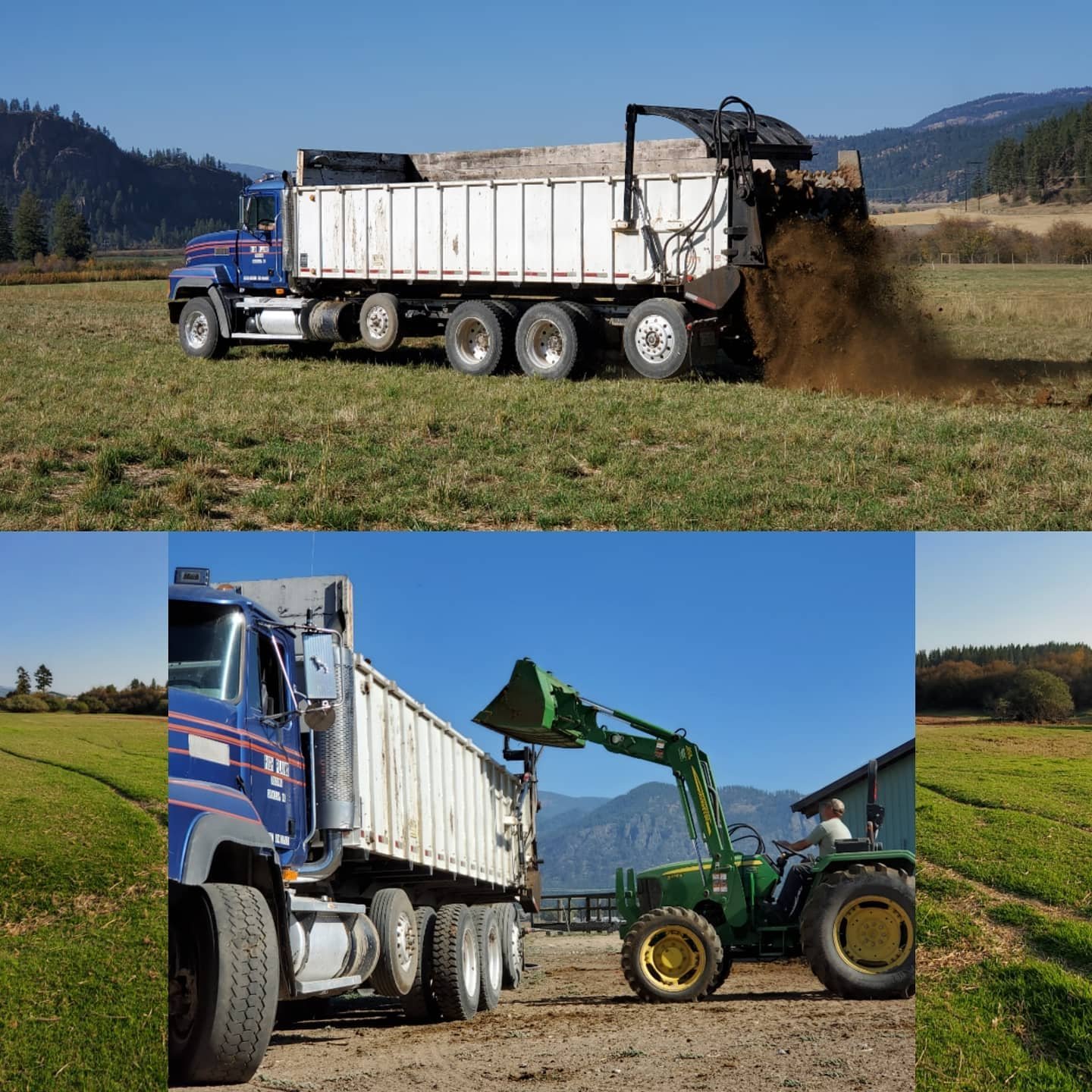
Loading and spreading of composted manure - Bettering the environment.

Ranch Store Shopping
We make it easy to get your meat and other products including seasonal produce.
- Ranch Pickup (by appointment only).
- Home delivery
- Pickup locations through eastern Washington and Northern Idaho, including farmers markets.
- No order is too small - order as little or as much as your need or can store.


Our ranch has been vetted by Regenerative Farmers of America
If you would like more information and resources on regenerative Ag please visit their website at www.regenerativefarmersofamerica.com